

I’ll generate you more traffic, more phone calls, and more sales on autopilot.
Click here for your free lead generation audit and consultation. I’ll bring you the leads and the customers so you can run your business.
Today, we are diving into a massive announcement Google just dropped regarding the future of its advertising platform.
These updates are heavily centered around AI, and they completely rewrite the playbook for how we generate leads.
LFG. 🔥
Google Is Attempting To Take Out The Human Being In Advertising
The announcement surfaced last week on Google’s marketing blog, revealing four major overhauls hitting the platform. Let’s dissect them one by one to see what we are dealing with.
1. Ads In AI Mode And AI Overviews
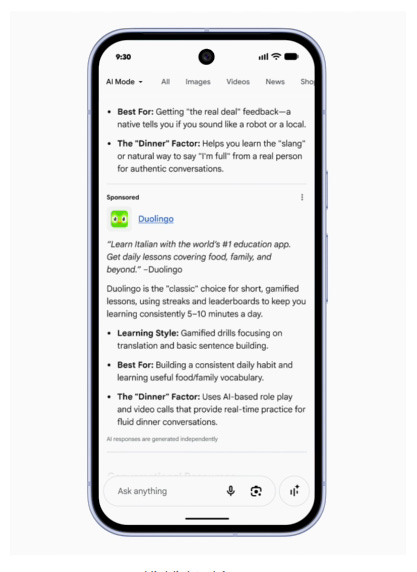
AI mode officially belongs to the advertisers now. What makes these new ads unique is that Google will deploy AI to engineer the creative copy on the fly, tailoring each ad to match the exact context of the user’s prompt. For example, a Duolingo ad can now morph its copy in real time to blend seamlessly into the AI interface while answering highly specific user questions.
2. AI Powered Shopping Ads
Google is also hijacking the creative process for e-commerce.
“Now, if someone searches for an espresso machine, Gemini will pull up your most relevant products and instantly write a custom explainer highlighting why your product may be the right choice for them.”
3. Business Agent For Leads
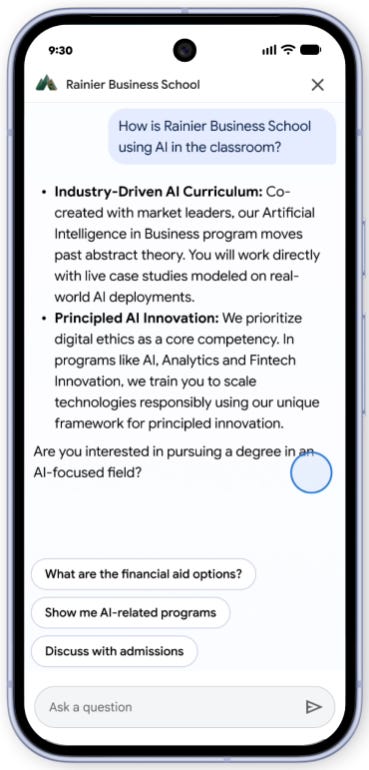
Instead of relying on standard form extensions, which traditionally capture a static lead, Google is embedding dynamic AI chatbots directly into the ad experience.
The moment a user triggers your ad, they won’t just submit their information to sit in a queue. Instead, an AI chatbot immediately intercepts them to engage in a live conversation.
4. Google Is Expanding Direct Offers Pilot
The direct offers pilot has graduated from its quiet Beta phase, and Google is aggressively rolling it out to the broader advertising ecosystem.
This expansion allows brands to inject direct response offers straight into the heart of the AI mode interface.
My Initial Thoughts On These New Upgrades
I hate them. Let me explain why.
I try to practice enough self awareness to know that whenever a tech giant upends the status quo, the gut reaction is usually driven by fear. But I have purposefully embraced AI with open arms from day one. It was instantly clear to me that AI is an inevitability, and the smartest move was to integrate it into my daily workflow as fast as humanly possible.
Yet, despite my optimism, my hands on experience with fully AI generated ads has been incredibly underwhelming.
To put it bluntly, they flat out underperform.
Google and Meta are desperately trying to engineer a world where advertisers completely abdicate control. They want you to believe the machine can handle everything. The AI will:
manufacture the creative assets
dictate the targeting parameters
engineer the tracking architecture
distribute the ads to the exact pockets of data it deems worthy
Despite the hype, I have yet to witness a single scenario where the algorithm outclasses a skilled human marketer.
This gap is glaringly obvious when it comes to audience targeting. Manually auditing, tweaking, and sculpting direct search campaigns over time yields vastly superior returns compared to blindly running PMAX or AI Max campaigns.
As it stands right now, the machine is simply no match for human intuition when it comes to driving high quality leads for my businesses and my clients.
Side Note: This failure to launch is equally obvious in automated communication. Conversational AI chatbots consistently choke when compared to a traditional phone funnel. Nothing converts a prospect quite like getting them on the phone with a hungry sales rep, which is why I have zero faith in Google’s new automated chat functionality.
Conclusion: Don’t Let AI Become A Crutch
The deeper I venture into the AI sandbox, the easier it is to map out exactly where the technology triumphs and where it hits a brick wall.
My verdict is simple. AI is an absolute powerhouse at aggregating massive datasets and spotting macro trends, but it remains lightyears behind the human mind when it comes to deductive reasoning, creative nuance, and contextual decision making.
Because of that, my ultimate warning to you is simple: do not outsource the soul of your business to an algorithm.
By all means, experiment with these new toys and find clever ways to weaponize the technology to optimize your workflow, but never let a machine do your thinking for you.
Your future self will thank you for keeping your hands on the wheel.
Love you guys. Talk to you tomorrow.
Tim


